

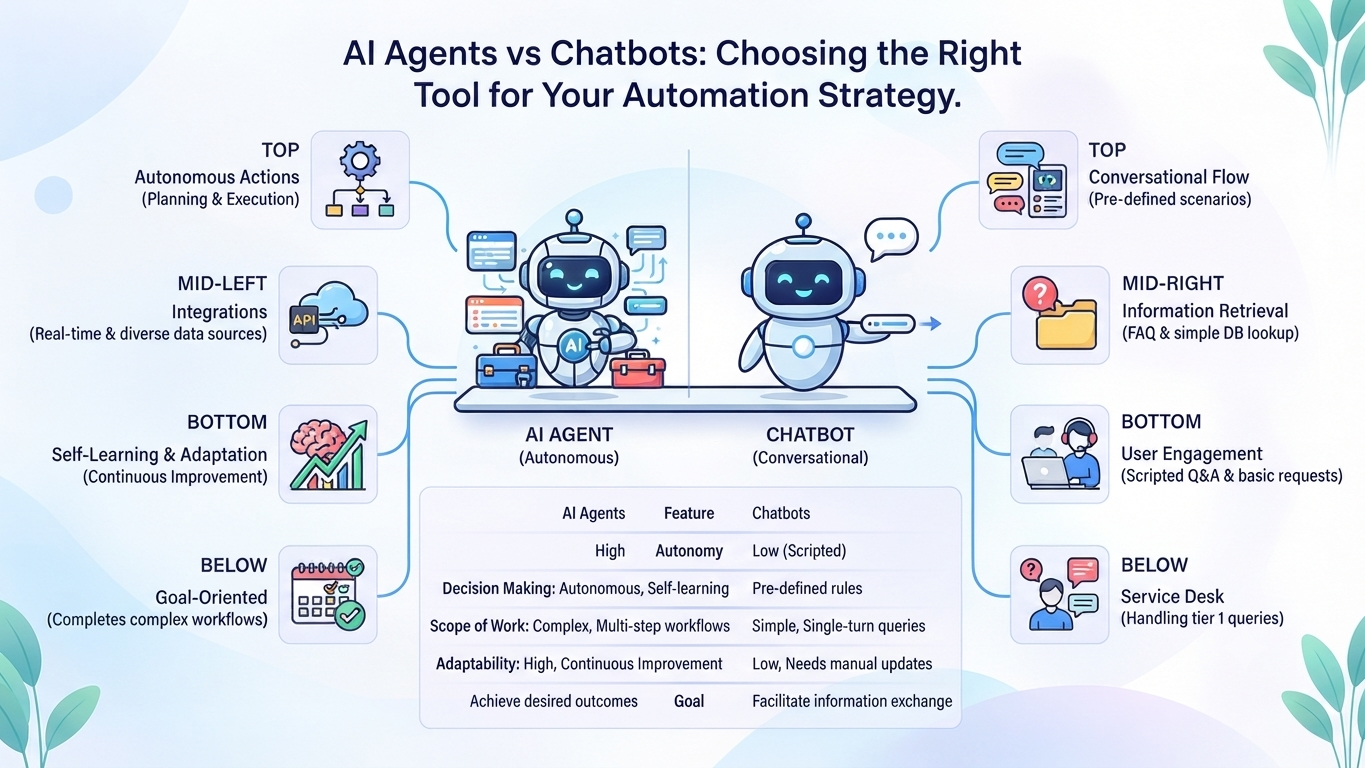
"AI agent" has become one of those terms that gets attached to almost anything with a language model behind it, including plenty of things that are really just chatbots with a new label. The distinction matters if you're deciding what to actually build.
A chatbot, at its core, takes an input and returns a response — it's a single-turn (or multi-turn conversational) mapping from question to answer. An agent goes further: it can take actions in the world — calling APIs, updating a database, triggering a workflow — and can chain several of those actions together to complete a task, adjusting its plan based on what happens at each step.
If your use case is "answer common customer questions," a well-tuned chatbot with good retrieval over your documentation will get you most of the value at a fraction of the complexity and risk of an agent. If your use case is "process a refund request end-to-end" or "reconcile data across three systems," that requires an agent capable of taking real actions — and that comes with real questions about permissions, error handling, and what happens when it gets something wrong.
The moment an AI system can take an action rather than just suggest one, you have to define exactly what it's allowed to do unsupervised versus what needs a human approval step. Teams that skip this early almost always add it back in after the first incident. Building it in from the start is cheaper than retrofitting it.
Our default recommendation for a first AI feature is narrower than most teams expect: a well-scoped assistant with retrieval over your own data, with clear boundaries on what it can and can't do, and a human-in-the-loop step for anything consequential. Full autonomous agents are powerful, but they're also where most of the current failure stories come from — not because the technology doesn't work, but because the scope wasn't constrained enough for the risk involved.
Before calling something an "AI agent" in your product roadmap, ask what actions it will actually be allowed to take, and what happens the first time it gets one wrong. If you don't have a confident answer yet, you're not ready to build the agent version — start with the assistant version and earn your way up.